
Green surfactants, also known as eco-friendly surfactants or biodegradable surfactants, address the severe harms caused by traditional surfactants to human health and ecosystems during production and use. Adding surfactants to detergents enhances solubility and cleaning power, but their toxicity can irritate skin. Extensive use poses ecological risks; for instance, sodium alkylbenzene sulfonate (ABS) has poor biodegradability, leading to foam overflow in urban sewers and rivers; phosphate-containing surfactants cause eutrophication in water bodies; and the production of linear alkylbenzene sulfonate (LAS) generates sulfur dioxide and sulfur trioxide, while fatty alcohol ethoxylate sulfate (AES) products contain dioxane substances that are hard to biodegrade, posing significant environmental hazards.
To meet growing health demands and ensure sustainable human environments, developing green surfactants that are minimally toxic to humans and non-polluting to ecosystems is imperative.
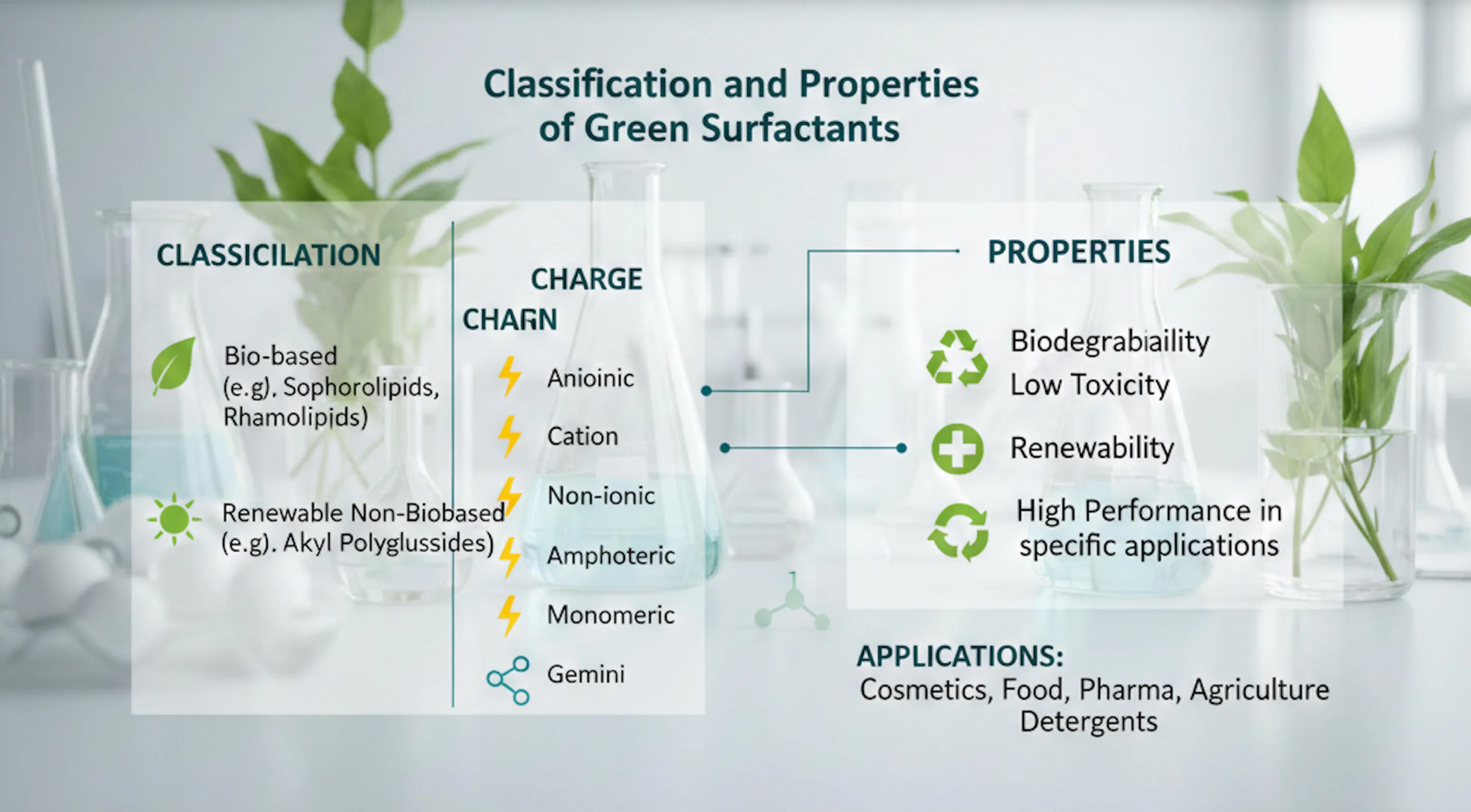
Classification and Properties of Green Surfactants
Green surfactants refer to surfactants processed from natural or renewable resources, with low irritation to humans and easy biodegradability. Based on dissociation in water, green surfactants are divided into nonionic and ionic types. Ionic green surfactants are further classified by their active ions into cationic, anionic, and zwitterionic.
Green surfactants are derived from natural or renewable resources, featuring naturalness, mildness, and low irritation. Like traditional surfactants, they have hydrophilic and hydrophobic groups. Compared to conventional ones, green surfactants offer high-efficiency detergency, excellent compatibility, and good environmental compatibility, exhibiting superior emulsification, detergency, solubilization, wetting, solubility, and stability.
Additionally, each type of green surfactant has unique properties; for example, α-sulfo fatty acid methyl ester (MES) shows surface activity at low concentrations and hard water resistance, while monoalkyl phosphates (MAP) provide excellent foaming, emulsification, antistatic properties, and skin affinity. Common green surfactants include α-sulfo fatty acid methyl ester (MES), alkyl polyglucosides (APG), glucosamides (APA), alcohol ether carboxylates (AEC), monoalkyl phosphates (MAP), and alkyl glucosamides (MEGA).
Properties, Applications, and Current Status of Several Green Surfactants
Green surfactants possess naturalness, mildness, and low irritation. They feature hydrophilic and hydrophobic groups like traditional surfactants but surpass them in high-efficiency detergency, compatibility, and environmental compatibility, with excellent emulsification, detergency, solubilization, wetting, solubility, and stability.
Alkyl Polyglucosides (APG)
Alkyl polyglucosides (APG) are a new generation of environmentally friendly green surfactants, synthesized from natural or renewable raw materials like glucose from starch and fatty alcohols, yielding nonionic alkyl polyglycosides. They exhibit excellent foaming, low human irritation, easy biodegradability, low surface tension, good detergency, rich and fine foam, strong compatibility with any surfactant type for obvious synergistic effects, broad-spectrum antimicrobial activity, easy dilution without cloud point or gelation, user-friendliness, and strong alkali and salt resistance.
APG raw materials—oral glucose and fatty alcohols—are non-toxic and non-irritating, positioning them as replacements for traditional surfactants with broad application prospects. They are widely used in pesticide intermediates, detergents, cosmetics, food, medicine, firefighting, textiles, printing and dyeing, petroleum, and other industries.
Recent advancements show APG leading growth in green surfactants, with high biodegradability and low toxicity, ideal for personal care and enhanced oil recovery.
Fatty Alcohol Polyoxyethylene Ether Sulfates (AES)
Fatty alcohol polyoxyethylene ether sulfates (AES) are produced by addition reaction of higher fatty alcohols with ethylene oxide, yielding fatty alcohol polyoxyethylene ether, then sulfation. AES is an important anionic surfactant class with excellent hard water resistance, foaming, low-temperature performance, rapid biodegradation, low skin irritation, good enzyme compatibility, transparent stable solutions, and easy viscosity increase with electrolytes. Widely used in liquid detergents, low/no-phosphorus detergents, and personal care, AES is China’s mainstream anionic green surfactant. New variants include branched fatty alcohol sulfates (GAS), phosphates (GAP), and their ethoxylated versions (GAES, GAEP).
Fatty Acid Methyl Ester Sulfonates (MES)
MES represent a new generation of green surfactants, researched for over half a century. Major detergent companies praise MES for superior performance from natural renewable resources, good biodegradability, and eco-friendliness. MES are mild, with lower irritation/toxicity than LAS, comparable to AS/AES. No oral toxicity, practically non-toxic to aquatic life. Good detergency in cold/hard water, outperforming LAS/AS—especially in hard water, addressing LAS’s weakness. Phosphorus-free, outperforming LAS without alkali/tripolyphosphate, ideal for eco-detergents.
Despite advantages, MES production lingers around 20,000 tons annually due to challenges: deep color, hydrolysis during bleaching to disodium salts (poor performance), poor thermal stability in alkaline water, formulation difficulties.
Ongoing research addresses these for broader adoption.
Biodegradable Gemini Surfactants
Gemini surfactants feature special dimeric structures: typically two (or three) hydrophobic chains, two hydrophilic groups, and a linker (near heads), which can be hydrophilic or hydrophobic. Compared to monomers, Gemini surfactants offer: high surface activity; low Krafft point/good solubility; higher efficiency reducing water tension; stronger monomer synergies; excellent calcium soap dispersion; stronger oil/water tension reduction; enhanced oil solubilization; lower skin irritation.
Gemini surfactants excel among new products, but high costs limit industrialization to few products.
Recent advancements focus on bio-based, ester-linked Gemini surfactants for improved biodegradability, antimicrobial activity, and applications in personal care/environmental remediation.
Polyepoxysuccinic Acid (PESA) and Polyaspartic Acid (PASP)
Polyepoxysuccinic acid (PESA), developed in the early 1990s by Betz Laboratories, is a phosphorus/nitrogen-free, biodegradable green corrosion/scale inhibitor. PESA offers excellent scale/corrosion inhibition, outperforming sodium polyacrylate, polymaleic acid, tartaric acid. Suitable for high-alkali/high-solids systems in boiler/cooling water treatment, wastewater, desalination, membrane separation.
Clean production; post-use, efficiently degraded by microbes/fungi to harmless products—”environmentally friendly” green chemical. Hot research topic domestically/internationally, faster abroad recently.
Polyaspartic acid (PASP) polymerizes from aspartic/maleic acid under catalyst. Widely in cooling/boiler water, desalination, sugar recovery, reverse osmosis—especially oil drilling as calcium carbonate/barium/strontium sulfate inhibitor. Extensive foreign research on synthesis/structure/performance, with industrialization; domestic broad studies. PASP’s excellent biodegradability/high inhibition makes it a true green scale inhibitor.
For more on related products, visit Surfactants. Questions? Contact us. In summary, green surfactants like APG, MES, biodegradable Gemini surfactants, PESA, and PASP advance sustainability, offering eco-friendly surfactants with minimal impact.
Summary of Surfactant Knowledge Points
A Series for Easy Understanding
Green surfactants
- Classification and Properties of Green Surfactants
- Natural Polysaccharide-Based Green Surfactants
- Properties and Applications of Anionic Amino Acid Surfactants
- Synthesis Processes of Anionic Amino Acid Surfactants
- Microbial Surfactants: Sophorolipids
- Types and Structures of Cardanol-Based Surfactants
New surfactants
- Synthesis and Applications of Phosphate Ester Surfactants
- Gemini Surfactants and Their Antibacterial Properties
- Low-Foam Surfactants: Types, Properties, and Applications
- Impact of Polyether Structure on Product Performance
- Types and Applications of Isomeric Alcohol Special Surfactants
- Research Progress on Secondary Alcohol Ethoxylates